
Waltham Butternut Winter Squash Seeds - (Cucurbita moschata)
- SKU:
- V1367
- Seed Count:
- Approx 25 seeds per pack
- Days to Maturity:
- 83-115 days
- Type:
- Winter
- Status:
- Heirloom, Non-Hybrid, Non-GMO seeds





Description
Waltham Butternut Winter Squash – Smooth as Butter, Sweet as a Nut
We have all passed it a thousand times in the grocery store aisle—that smooth, heavy, tan cylinder sitting quietly in the produce bin. You might think you already know exactly what it is, and exactly how it tastes. But in reality, you probably only know half the story.
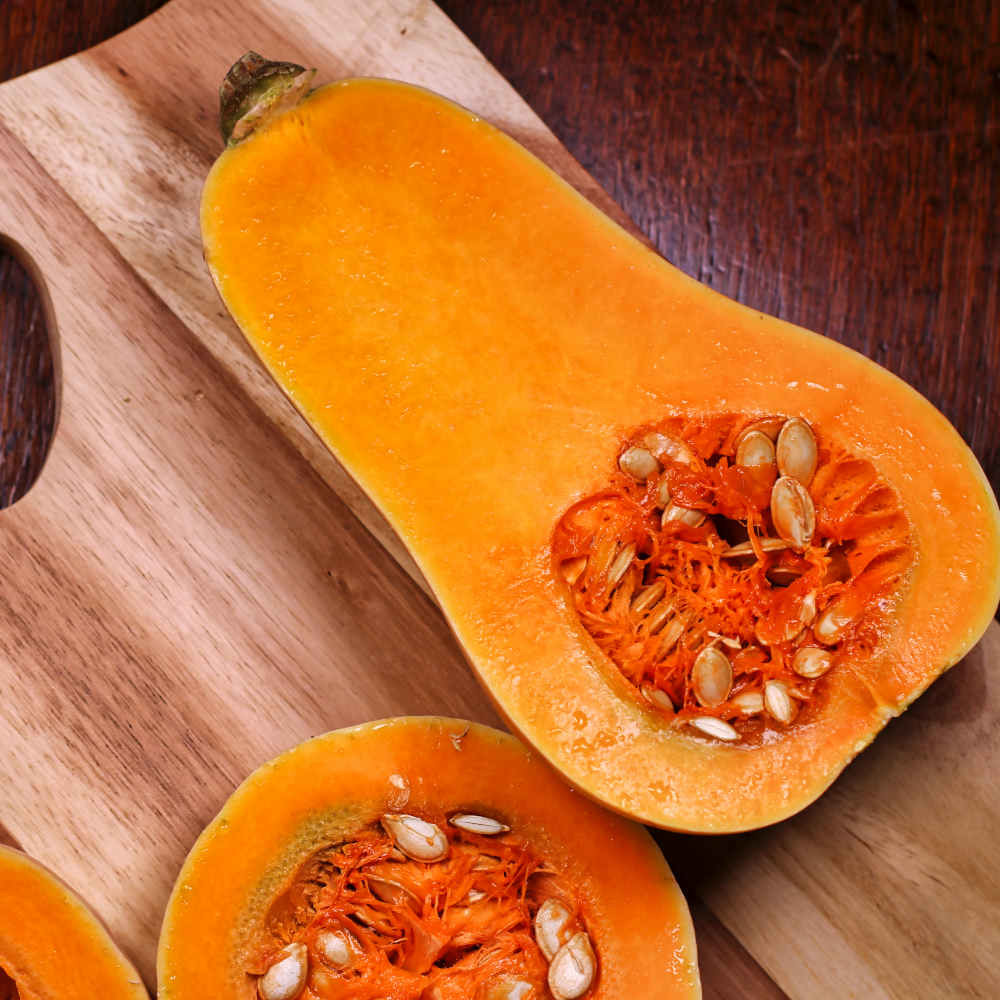
It begins with a flavor that has to be tasted to be believed. When it is grown right, the flesh is a deep, vibrant orange that roasts up with caramelized edges, offering a velvety, melting texture that is clean, rich, and distinctly nutty. It is everything we want in a winter meal. Yet, here is something that only home gardeners know: that legendary flavor doesn’t happen on the vine.
The full flavor requires darkness and time.
After you cut this squash from the vine, you tuck it away in a cool, quiet corner of your pantry or cellar for a couple of months. While the autumn days fade and winter arrives outside, a quiet shift takes place beneath that tough tan skin, where hidden starches slowly turn into rich, buttery sugars. By the time the depth of winter arrives in January and February, you split it open to find that the squash has brought the warm color and concentrated sweetness of the late summer sun right back to your kitchen table.
Dedicating a corner of your garden to these vigorous vines is an investment in your winter pantry. But to get to that winter payoff, this butternut squash relies on a few remarkable secrets during the summer growing season—hidden features built right into its leaves and stems that only the home gardener ever gets to see.
Details
The Waltham Butternut is a vigorous winter squash that grows as a sprawling vine, often reaching ten to fifteen feet across the soil surface. A single healthy plant typically produces four to five uniform squashes, making it a highly productive staple for the home garden. Its massive, twelve-inch shield-shaped leaves feature dark-green lobes and striking silver-white markings along the veins. If you run your hand across a leaf or stem, you will feel a coarse, sandpaper-like texture; this grid of microscopic bristles serves as a natural cooling system to shed afternoon heat and makes the leaves difficult for soft-bodied pests, especially squash bugs, to navigate and feed upon.
Each plant produces separate male and female flowers. Male flowers appear first on slender stalks to attract pollinators with their mild fragrance, followed by four-inch, trumpet-shaped female blooms identified by the miniature fruit at their base. Waltham stalks are fundamentally different from typical summer squashes; they are solid and packed with woody lignin, making it physically difficult for the Squash Vine Borer to work its way into the stem.
For gardeners with limited space, the Waltham accepts training up a sturdy trellis or fence. To get the best results, we suggest training most of the vines to climb while allowing a few to run along the ground. This allows the variety to put down the secondary roots it uses to draw extra moisture and nutrients—a backup system that keeps the vine productive even if the central stem sustains damage. If you grow in a container, use a minimum volume of fifteen to twenty gallons to ensure the roots stay cool and moist enough to support the large leaf canopy.
The fruit matures into a uniform cylinder with a tan skin and a thick, seedless neck. While sitting in storage, the squash continues a natural ripening process, slowly changing its internal starches into sugars, which results in the peak flavor this squash is known for, months after the harvest.
This variety produces reliably as a summer annual across USDA Zones 3 through 10.
Gardeners in northern latitudes must wait until the minimum soil temperature is 65° F. Planting before the earth is warm enough can stall growth.
History
Before the 1930s, varieties like 'Canada Crookneck' dominated North American gardens, but their sprawling, irregular forms made them difficult to handle and store.
The transition to the efficient butternut shape began in the late 1930s on Charles Leggett’s 90-acre homestead in Stow, Massachusetts. Leggett, a homesteader with an eye for practical utility, aimed to synthesize a compact, stackable squash by crossing various types in his garden. His selective breeding resulted in a fruit he famously described as being "smooth as butter and sweet as a nut," establishing the entirely new 'Butternut' classification.
To permanently lock these traits, Leggett partnered with Professor Robert E. Young at the Waltham Field Station. They bred the partially stable 'New Hampshire Butternut' with a wild, neckless variety from Africa to provide the final genetic stabilization. This cross-breeding ensured the thick, seedless neck and predictable size we rely on today while maintaining the woody, borer-resistant stems. Formally introduced in 1968, the variety won the All-America Selections award in 1970 and remains the undisputed gold standard for winter squash.
Uses
Butternut squash excels in the kitchen, such as roasting, steaming, sautéing, and grilling. Its dense, smooth flesh can be sliced into rounds or cubed for use in curries, soups, and stews, or used as a unique filling for tacos, ravioli, and empanadas. For a hearty breakfast, it replaces potatoes in a hash. In baked goods, its natural sweetness enhances pies, breads, and muffins. Even the seeds provide value; they are popularly roasted and salted as a snack. The Waltham pairs naturally with savory herbs like sage and thyme, and rich fats like butter, cream, and bacon.
Companion Planting
Leverage the sprawling habit of the Waltham to your advantage by using its massive leaf canopy as a living mulch to shade the soil, preserve moisture, and suppress weeds. Pair it with nitrogen-fixing bush beans to build a self-managed nutrient cycle within your garden bed.
Avoid planting with other aggressive vining crops that may compete for the same sunlight and soil volume.
Planting and Growing Tips
Remember the minimum soil baseline temperature of 65°F, as planting in cold earth stalls plant growth and fruit development. This variety requires about 105 days to reach full maturity before the first autumn frost.
Harvest Tips
Harvest only when the fruit's skin has turned a uniform tan and the rind is hard enough that it cannot be easily punctured by a fingernail. The stem should also appear dry and woody. Use sharp shears or a knife to separate the fruit from the vine, making sure to leave one to two inches of the stem attached to the fruit; removing the stem completely creates an open wound that can lead to rot during storage. Proper curing is essential; it initiates the hardening of the skin, which creates a natural seal. Store your harvest in a cool, dry environment between 50-60°F to ensure your squash remains fresh for typically 3 to 6 months.
Think of this squash as a harvest that actually improves the longer you wait to eat it. While most vegetables are best the moment they are picked, the Waltham reaches its peak sweetness after several weeks in storage. During this time, the natural starches inside the fruit transform into sugars, rewarding your patience with a much richer flavor than a squash fresh off the vine.
Learn More
- Steam Spaghetti Squash with Pasta Sauce
- Roasted Butternut Squash Soup
- Squash Bugs and Ways to Deal With Them
From the soil to the seed to the food you eat - we'll help you grow your best garden!
Related Products
Related Products
Vegetable Spaghetti Winter Squash Seeds - (Cucurbita pepo)
Early Summer Crookneck Squash Seeds - (Cucurbita pepo)
Zappallo de Tronco Squash Seeds - (Cucurbita maxima)

Cocozelle Zucchini Summer Squash Seeds - (Cucurbita pepo)

