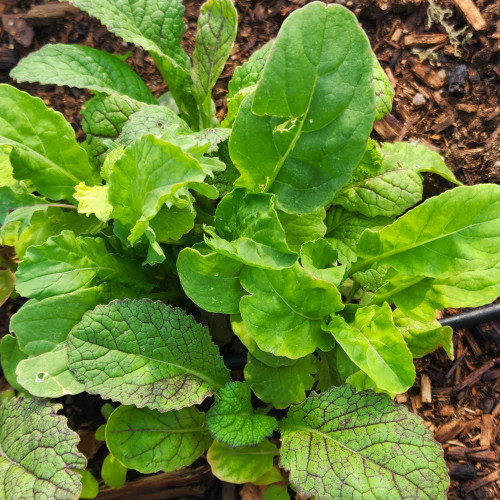
Sweet Basil Seeds - (Ocimum basilicum)

- SKU:
- H1112
- Seed Count:
- Approx 50 seeds per pack
- Type:
- Annual
- Days to Germination:
- 7-14 days @ 70-85F
- Plant Spacing:
- 8-12"
- Light Preference:
- Full sun
- Soil Requirements:
- Well drained, warm
- Status:
- Heirloom, Non-Hybrid, Non-GMO seeds


Description
Sweet Basil - Spicy-Sweet Clove and Licorice Flavors
If you walk out into your garden after a long day of heat, before the sun has completely dropped, and just brush your hand against a leaf, you’ll understand why this plant has survived for two thousand years. It’s not just an herb for a kitchen shelf; it’s a livinghistory that smells like clove-smoke and licorice, designed to announce its presence across the entire bed. You aren't just growing a garnish; you’re nurturing a royal descendant that knows how to defend itself, signal its neighbors, and turn a simple meal into a high-performance sensory event that stays on your tongue long after the sun goes down.
Details
Sweet Basil is a sturdy, bushy, upright grower that reaches a height and spread of 18 to 24 inches, supported by strong, square-edged stems that mark it as part of the mint family. When properly managed, it develops into a dense, rounded canopy of large, glossy green leaves that grow in pairs on opposite sides of the stem. These leaves are delicate and succulent, serving as the plant's on-board storage for its scent and flavor. The underside of each leaf is covered in thousands of tiny, microscopic scent-pouches that are under high internal pressure. They are built to pop at the slightest touch—whether by wind, rain, or the heat of the sun—releasing the plant's signature earthy fragrance into the air.
Beneath the soil, the roots act like a smart hydraulic system. In open ground, it drives a deep, cone-shaped anchor root to secure against the wind. In a container, it retools its approach, developing a dense web of shallow roots with a massive surface area to capture every drop of moisture and nutrients available. Basil has a self-regulating system, using water to maintain its structural rigidity, much like air pressure keeps a tire inflated. It constantly adjusts this internal pressure to stay upright and cool, because it needs maximum solar energy to make its oils. However, it is incredibly fragile in mild cold. The moment temperatures drop below 50°F, the internal pipes literally burst, and the leaves turn black.
To survive intense heat, the plant has a unique survival shield—a thin, waxy coating that locks moisture inside the leaf. At the same time, it manages its breathing pores by shrinking them during the hottest part of the day, keeping it healthy without drying out. Getting the most out of every drop of water is what allows this basil to thrive and keep producing flavor even in high-heat gardens.
History
Sweet Basil didn't earn its name as the "King of Herbs" by accident; it was a 5,000-year selection process designed to sharpen the flavor profile of the garden. While the plant began in the high-heat regions of India and Southeast Asia as a sacred herb, it was the Roman kitchen that first realized its potential in the kitchen.
The Romans used basil to heighten success. Apicius, the legendary Roman gourmand, documented basil as a primary seasoning to brighten heavy legume dishes like pea soup and as a specialized additive to sharpen the flavor of cured olives. In the Roman garden, basil was used as a magnifier to enhance the dining experience, moving it from a temple herb to a staple of the household plot.
The Renaissance is the era where the plant’s characteristics were fully selected and developed for sweetness. By the mid-1500s, spice traders had carried the seeds into Western Europe, where gardeners began a centuries-long selection process to dial back the harsh, camphorous notes found in wild varieties. They were looking for a specific aromatic tolerance—one that prioritized the clove-like sweetness we value today.
During this period, the great English herbalist John Gerard recorded using basil steeped in strong wines to sharpen the senses and clear the head, effectively treating the herb as a high-octane tonic for the mind. By the time the 1600s arrived, basil had crossed the Atlantic to America, where it was immediately integrated into the colonial garden as a sign of hospitality and good fortune.
In 1885, the famous Vilmorin seedsmen documented the "Lettuce-Leaf" and "Sweet" varieties as the pinnacle of garden selection. This was the moment the basil we grow today was finalized—a variety selected specifically to hold its flavor under the heat of a summer afternoon and provide the massive, aromatic yields required for the regional sauces of Genoa. This seed is the result of that long-term care, a plant that has been continuously refined to provide the maximum reward for the home gardener.
Uses
Sweet Basil is the secret behind authentic pesto, but its kitchen potential is much broader. The large, succulent leaves are ideal as wraps for appetizers—try wrapping them around fresh mozzarella and ripe tomatoes, or use them to encase poultry or fish before cooking to infuse the meat with heat-stable oils. In the kitchen, it’s best to hand-tear the leaves rather than using a metal blade to avoid a metallic reaction that dulls the scent. Young leaves offer a milder, sweeter profile, while mature leaves develop an intense, spicy-sweet character that holds up well in slow-simmered sauces. For the best result, add your fresh harvest at the final stage of cooking to preserve the oils.
Companion Planting
Sweet Basil is an active partner in your garden, particularly for tomatoes and peppers. When the leaves are disturbed, they broadcast a chemical signal that prompts neighboring plants to toughen their own defenses.
Beneficial Companions: Tomatoes, peppers, oregano, and chamomile make excellent pairings, offering mutual benefits in pest deterrence and improved flavor.
Antagonists: Keep rue and sage elsewhere, as they can negatively impact the basil’s growth.
Biological Screen: The intense scent profile confuses the navigation of flies and mosquitoes; a few pots near doorways can act as a natural deterrent.
Planting and Growing Tips
Start with warm soil—70°F or higher—to ensure a reliable start. In northern climates, start seeds indoors where you can control the heat before the spring chills have passed. Once in the garden, maintain 12 to 18 inches of space between plants; this airflow is your primary defense against molds that thrive in stagnant air. During summer heat waves, keep the soil consistently moist. The plant uses water as an internal coolant; if the soil dries out completely during a thermal peak, the internal plumbing can fail permanently.
Harvest Tips
Begin harvesting once the plant is about 6 inches tall to promote a bushier habit. Harvest in the morning after the dew has dried but before the midday heat pulls the oils back into the center of the plant. Left to its own devices, basil wants to flower and make seeds. Keep an eye out for any flower buds and pinch them off as soon as they show up—once the plant starts flowering, it stops putting energy into the leaves, and the flavor starts to turn bitter. This stops the plant from flowering, keeping it producing new leaves.
Learn More
- All About Basil
- Heirloom Basil - So Much More Than Pesto
- Easy Homemade Basil Pesto
- Fresh Heirloom Basil Recipes
From the soil to the seed to the food you eat - we'll help you grow your best garden!
Related Products
Related Products

Genovese Basil Seeds - (Ocimum basilicum)

Thai/Asian Basil Seeds - (Ocimum basilicum)

Lemon Basil Seeds - (Ocimum basilicum var. citriodorum)

Holy Basil Seeds - (Ocimum sanctum)