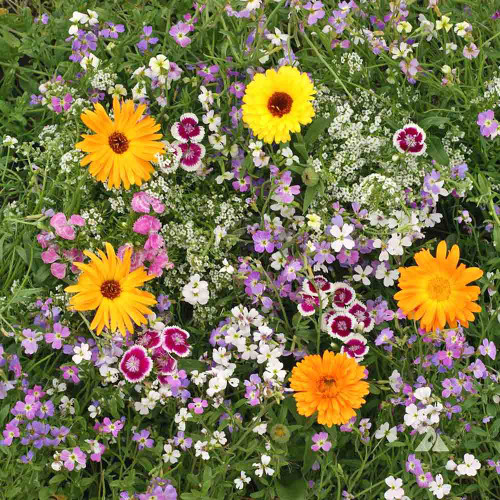
Snapdragon Dwarf Fairy Bouquet Seed Mix - (Linara maroccana 'Fairy Bouquet')

- SKU:
- F1221
- Seed Count:
- Approx 100 seeds per pack
- Type:
- Annual
- Status:
- Heirloom, Non-Hybrid, Non-GMO seeds







Description
Snapdragon Dwarf Fairy Bouquet Seed Mix - Colorful Living Confetti
The Snapdragon ‘Fairy Bouquet’ is the unsung hero of the early spring garden. While often admired for its high-density "living confetti" of color, its true value is feeding the awakening garden: it is busy working to bridge the "Hunger Gap."
In the critical window of early spring—when queen bumblebees emerge, and the landscape is still waking up—this plant is a biological lifeline. It doesn't wait for the garden to warm up; it actively converts cold moisture and soil nutrients into high-energy nectar weeks before the rest of the garden comes online. By planting ‘Fairy Bouquet’, you aren't just filling the silence with color; you are installing a critical food source that supports the entire early-season ecosystem.
Details
‘Fairy Bouquet’ represents a specific selection of snapdragon that produces a high-density "drift" of upright, slender stems reaching 9-12 inches in height. The foliage is soft and needle-like, spiraling up the stem in a "fern-like" texture that mimics its cousin, flax. This airy structure creates an excellent textural contrast for plants with bolder, heavier leaves.
The bloom itself attracts attention. Each tiny blossom, measuring approximately ¾ of an inch, mirrors a perfect miniature version of a snapdragon, featuring two distinct "lips" and a long, slender spur trailing behind it. Most flowers display two colors—shades of purple, lavender, violet, pink, rose, red, cream, yellow, and white, often featuring a bright, contrasting patch of yellow or orange on the lower lip. This acts as a "landing strip," a clear signal that directs pollinators exactly where they need to go.
When planted densely, as it prefers, the individual plants merge into a single, striking tapestry of violet, pink, rose, cream, and white. Treat this strictly as a cool-season annual; it thrives in the shoulder seasons of spring and late autumn. It withstands light frosts but will fade once summer temperatures consistently exceed 80°F.
History
The genus Linaria takes its name from Linum (flax), referencing the similarity of their foliage before blooming. While widely distributed across the Northern Hemisphere, this snapdragon is native to the Atlas Mountains of Morocco. It evolved in a Mediterranean climate characterized by cool, wet winters and hot, dry summers. This harsh climate has engineered a "sprint" metabolism: the plant must germinate, bloom, and set seed before the summer heat kills it.
From these mountains, it proved its resilience, naturalizing in disturbed soils across the United States—proof that this plant is wired for resilience, not fussiness.
‘Fairy Bouquet’ marks a turning point for this wildflower. This wasn't a chance seedling, but a deliberate creation by Watkins & Simpson, Ltd., a prestigious British wholesale seed merchant founded in 1876. Operating from the historic Covent Garden district, they released ‘Fairy Bouquet’ to critical acclaim, winning a Gold Medal from All-America Selections (AAS) in 1934.
The date of this award—1934—tells the real story. Arriving in the depths of the Great Depression, ‘Fairy Bouquet’ offered a specific psychological value: it was inexpensive, exceptionally easy to grow from seed, and bloomed with massive color. It served not just as a decorative plant, but as a symbol of resilience and hope, offering an astonishing return of beauty for a minimal investment during a challenging time.
Uses
This plant functions primarily as a first responder and refueling station for pollinators. It acts as a critical "early season pantry." When queen bumblebees emerge from hibernation, they are in desperate need of nectar to fuel the founding of their new colonies. The structure of the Linaria blossom, with its closed "mouth," only allows insects strong enough to push their way in, making it a dedicated reserve for bumblebees and long-tongued wild bees that can navigate the spur. By planting a dense stand, you anchor these populations in your garden before your main crops require their services.
Use ‘Fairy Bouquet’ as a premier "filler" flower for cut arrangements. Its diminutive stature (under 12 inches) makes it excellent for "posy" style bouquets or bud vases. In the landscape, it functions as "Biological Confetti," best used in mass plantings to fill empty spaces in borders or rock gardens.
Unlike the edible common Snapdragon (Antirrhinum), do not eat Linaria species; use them for ornamental and ecological purposes only.
Companion Planting
Plant alongside cool-season brassicas such as broccoli, cabbage, and kale. Brassicas do not produce nectar-rich flowers during their vegetative growth stage, meaning they offer no immediate reward to the beneficial insects needed to control aphids and cabbage loopers. ‘Fairy Bouquet’ acts as the bribe, drawing hoverflies and parasitic wasps into the brassica patch early in the season, establishing a predator population before pest pressure peaks.
Sow directly over patches of spring bulbs like daffodils and tulips. As the bulb foliage begins to yellow and die back—a necessary process for recharging the bulb—the rapid growth of the Linaria will rise to cover the unsightly fading leaves, maintaining the aesthetic continuity of the bed without competing for deep soil nutrients.
Planting and Growing Tips
These seeds are microscopic and need light to wake up. Burying the seed is the most common error, as it effectively smothers the germination. To establish the stand, prepare a fine-textured seedbed free of large clumps. Do not wait for warm weather; this is a cool-season sprinter that needs the chill to thrive. Simply scatter the seeds on the surface and press them into the soil without covering them, ensuring you keep that exposed layer consistently moist until germination occurs in 10 to 14 days.
Unlike many annuals that require strict spacing, ‘Fairy Bouquet’ thrives when crowded. Thinning is generally not required. Sowing a pinch of seeds every 4 inches allows the plants to grow together and support one another, creating the dense, impactful mass of color this variety is known for.
Zonal Strategy
- Zones 2-7 (Cold Winter): Sow in early spring, 4 to 6 weeks before the last frost date. For the earliest blooms, you may start seeds indoors 6 to 8 weeks before the last frost, provided you grow them in cool, bright conditions to prevent legginess.
- Zones 8-11 (Mild Winter): Reverse the strategy. Sow in late summer or early autumn. The plants will establish in the cooling weather and bloom profusely throughout the mild winter and into spring, fading only when the intense summer heat arrives.
Harvest Tips
This is a genuinely low-maintenance plant. If flowering begins to slow during the season, shearing the plants back lightly will encourage a fresh flush of blooms. For cut flowers, harvest in the cool of the morning when the bottom one-third of the florets are open, but the top buds are still tight and green. Immediately strip any foliage that would sit below the water line to prevent bacterial rot.
While Linaria is ephemeral with a vase life of 5 to 7 days, its production is prolific. If you are not harvesting for the vase, you must adopt an aggressive deadheading protocol. If the plant sets seed, its hormonal signal shifts, and the show will come to an end. Shearing back spent blooms forces the plant's metabolism to continue producing sugar and new flowers well into the season.
Learn More
From the soil to the seed to the food you eat - we'll help you grow your best garden!
Related Products
Related Products

Musquée de Provence/Fairy Tale Pumpkin Seeds - (Cucurbita moschata)

Terroir Seeds Cut Flower Seed Mix

Hummingbird & Butterfly Seed Mix

Edible Flower Seed Mix